

Have you heard of smog graffiti? It sounds strange, but it’s becoming a real form of eco-art. As atmospheric carbon dioxide levels have crossed critical thresholds—exceeding 400 ppm—we’re facing not just climate issues, but widespread air pollution problems that affect our health, environment, and daily life. Breathing polluted air can cause respiratory disease, fatigue, a compromised immune system, and affects future generations.
Globally, people have learnt of smog covering city skylines in thick haze, making one wonder: can we do more than just breathe it in?
Air-Ink: Pollution Remade into Paint
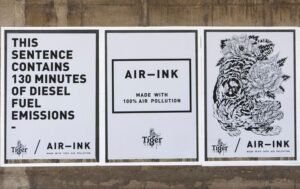
A project called Air-Ink, by Graviky Labs (an MIT Media Lab spin-off), captures air pollution (soot and carbon particles) from sources like exhaust, purifies it, and converts it into usable ink. The collected pollution is filtered to remove carcinogens, then repurposed into eco-friendly ink (spray cans, markers, pens). Artists can use this ink to create street art that literally comes from the same pollution they might otherwise inhale.
Some interesting facts:
-
The device used for collection is sometimes called KAALINK, which is attached to vehicles, generators, or boats.
-
A small amount of Air-Ink can represent many minutes of pollution collected.
-
Public murals using this ink have been done in cities like Singapore, London, New York, Berlin and more.
Why Smog Graffiti Matters
Turning pollution into art is not just a novelty—it has deeper environmental, social, and cultural significance:
-
Raises awareness — People see a mural made of smog, and it makes them think: “How much pollution am I contributing to?”
-
Art as activism — It blurs the lines between creative expression and environmental activism.
-
Alternative materials — Using smog-derived ink reduces reliance on traditional paints (which have their own environmental footprint).
How the Process Works (Safely)
To do this properly, there are a few key steps and safety measures:
-
Collection: Soot and carbon particles are captured from exhausts or industrial emissions.
-
Purification: The raw collected material is purified to remove harmful substances.
-
Ink formulation: Mixed into binders etc. to make it usable as ink or spray paint.
-
Application: Artists use it like regular paint—murals, tags, installations, etc.
Safety matters: the purification must ensure that the ink is non-toxic and stable. Also, the sources of pollution should be legally collected; artists and communities should check that regulations are followed.
Global Examples & Case Studies
-
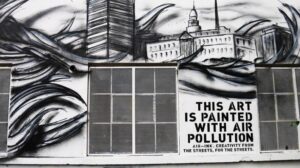
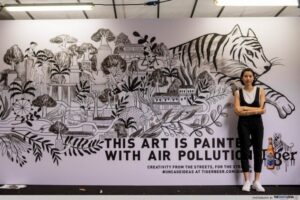
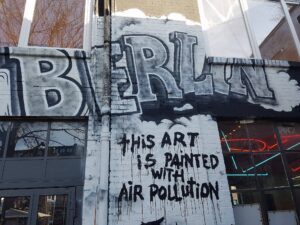
Berlin / London / New York: Artists have collaborated through Air-Ink and Tiger Beer to create public murals painted with smog ink. These artworks are visible in major urban spots. (See image 1 & 2 above: murals labeled “This Art is Painted With Air Pollution”)
-
Singapore (Orchard Road): Mural art using Air-Ink to engage the public in issues of air pollution.
-
Graviky Labs Projects Worldwide: They’ve made the tech available to artists globally and have done exhibitions, gallery shows, pop-ups, etc.
What This Means for Graffiti & Urban Art
With tools like Air-Ink, graffiti and street artists can:
-
Use more sustainable and symbolic materials.
-
Create work that also carries a message—art + environment together.
-
Encourage local authorities, urban planners, and community organisations to support creative forms of pollution awareness.
It’s an intersection of graffiti removal / control and graffiti as positive expression.
Challenges & Considerations
Even though Air-Ink and smog graffiti are exciting, there are issues to think about:
-
Scalability — How easy is it for artists everywhere to access smog-derived ink?
-
Regulation — Legal concerns if you’re collecting emissions from vehicles or generators.
-
Longevity — How weather-resistant is smog ink compared to regular paint? Fading, durability, risks with rain etc.
-
Health & Safety even after purification must be rigorously ensured.
Conclusion: Art That Speaks, Pollution That Inspires Change
Smog graffiti isn’t just art—it’s a statement. As air quality worsens globally, turning pollution into paint becomes one of the most potent symbols of how we can reclaim what harms us.
By using Air-Ink and similar graffiti-friendly environmental innovations, artists around the world are making pollution visible, transformable, and ultimately, meaningful. We need more creative solutions like this—tools that help us both see the problem and imagine the solution.


